
What is an ad spy tool? (And Why Should You Care?)
How Do Ads Spy Tools Work? An ad spy tool is software that collects, indexes, and displays active (and historical) advertisements running across platforms like Facebook, Google, TikTok, YouTube, and native ad networks.
Think of it as a search engine — but instead of web pages, it searches ads.
You can type in a competitor’s brand name, a keyword, or even a product niche, and instantly see:
- What creatives are they running (images, videos, copy)
- How long an ad has been active
- What landing pages are they sending traffic to
- Which countries or demographics are they targeting
- Estimated engagement metrics
Why does this matter? Because an ad that’s been running for 3 months isn’t a mistake — it’s a winner. Businesses don’t keep paying for ads that don’t convert. When you see a long-running ad, you’ve found a proven concept you can learn from (not copy — learn from).
Step 1: Understand How Ads Spy Tools Collect Data
How Do Ads Spy Tools Work? Before you start using one, it helps to understand what’s happening under the hood. There are three primary methods these tools use to gather ad data.
Method 1: Browser Extension Networks
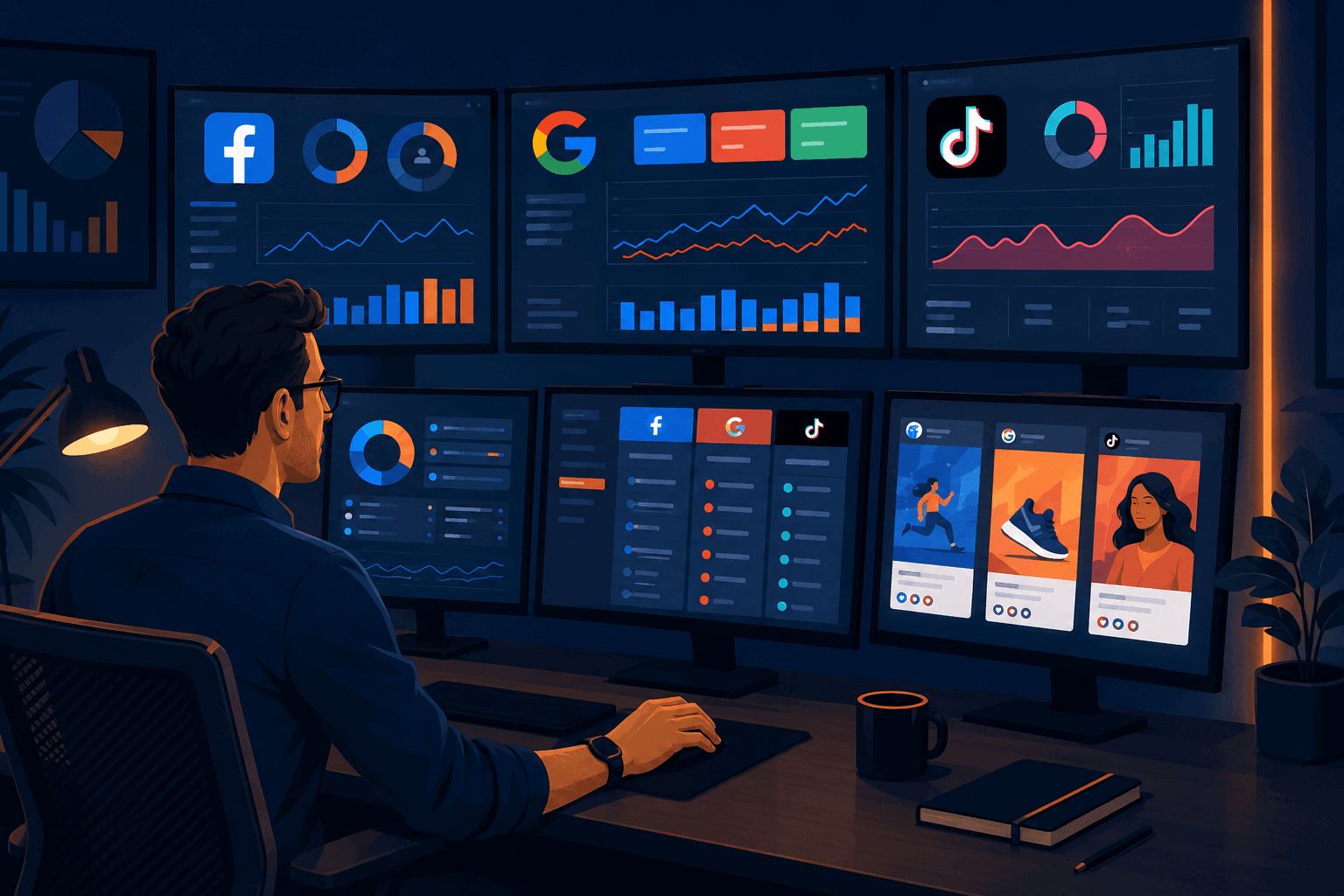
Many spy tools maintain massive networks of real users who have installed browser extensions. These extensions silently record the ads shown to those users as they browse Facebook, Instagram, YouTube, and other platforms.
Because different users have different profiles — different ages, locations, interests — the tool captures a wide variety of ads across many targeting segments.
Real-world analogy: Imagine you had 10 million friends around the world, each watching TV on different channels, and they all screenshot every commercial they saw. That’s essentially what these extension networks do — at internet scale.
Method 2: Platform API Access and Scraping
Some tools tap into public ad libraries directly. For example:
- Facebook’s Ad Library is publicly accessible and shows all active ads for any Facebook page
- Google’s Transparency Center shows verified ads by the advertiser
- TikTok’s Creative Center displays trending ads and top-performing creatives
Spy tools aggregate and enrich this data, adding filters, search functionality, and analytics that the native platforms don’t offer.
Method 3: Proprietary Crawlers and Bots
Advanced spy tools run automated bots that create hundreds of dummy user profiles with different demographic attributes. These bots “browse” social media and search engines the way real users would — triggering ad delivery systems and recording what gets served.
This is how tools capture ads targeted at very specific audiences that might not appear in public ad libraries.

Step 2: Learn What Data These Tools Actually Surface
How Do Ads Spy Tools Work? Once you log into a spy tool, you’re not just looking at screenshots. You’re accessing a structured intelligence database. Here’s what you typically get:
Creative Assets
- Images and videos — the actual visual content of the ad
- Ad copy — headlines, body text, CTAs
- Ad formats — carousel, single image, video, story, etc.
Performance Indicators
- First seen / Last seen dates — tell you how long the ad has been running
- Estimated impressions or reach — how widely the ad was distributed
- Engagement metrics — likes, comments, shares (where available)
- Active/inactive status — whether the ad is still running
Targeting Intelligence
- Geographic targeting — which countries, cities, or regions
- Device targeting — mobile vs. desktop breakdown
- Demographic signals — estimated age ranges and gender distribution
Funnel Data
- Landing page URLs — where the ad sends traffic
- Landing page previews — a snapshot of the full post-click experience
Practical tip: The landing page data is often more valuable than the ad itself. The ad gets the click; the landing page gets the sale. Study both.
Step 3: Choose the Right Spy Tool for Your Platform
Not all spy tools are created equal — and not all platforms are covered equally. Here’s a quick breakdown to help you pick the right one.
For Facebook and Instagram Ads
How Do Ads Spy Tools Work? Top tools: AdSpy, BigSpy, Minea, PowerAdSpy
Facebook is the most competitive intelligence landscape because the Ad Library already provides some public data. Third-party tools add deeper search filters, engagement sorting, and competitor tracking alerts on top of that foundation.
Best for: E-commerce brands, coaches, info-product sellers, lead gen campaigns
For Google Search and Display Ads
Top tools: SpyFu, SEMrush Advertising Toolkit, iSpionage
These tools focus on keywords competitors are bidding on, estimated CPCs, and ad copy variations. You can see the exact search terms your rivals are paying for — and how their copy evolves.
Best for: SaaS companies, local businesses, service providers running search campaigns
For TikTok Ads
Top tools: TikTok Creative Center (free), Minea, Pipiads
TikTok ad spying is newer, and data coverage is still maturing, but the TikTok Creative Center itself is surprisingly powerful. You can filter winning ads by industry, region, objective, and timeframe — completely free.
Best for: D2C brands targeting Gen Z and Millennials, viral product marketing
For Native and Push Ads
Top tools: Anstrex, AdPlexity, SpyPush
Native ad networks like Taboola, Outbrain, and MGID are heavily used by affiliate marketers and media buyers. Spy tools for these platforms reveal landing page funnels in great detail.
Best for: Affiliate marketers, media buyers, performance marketers
Step 4: Run Your First Competitor Search
Let’s walk through a practical example using a typical tool workflow.
4.1 — Start with a Competitor Brand Search
Type a competitor’s brand name into the spy tool’s search bar. Filter by:
- Platform: Facebook
- Status: Active (currently running)
- Date range: Last 90 days
You’ll instantly see every ad they’re running right now. Sort by “longest running” to find their evergreen performers — these are the creatives they keep coming back to because they work.
4.2 — Analyze Their Winning Patterns
Look for patterns across their top ads. Ask yourself:
- What emotion does the hook trigger? Fear, curiosity, excitement, FOMO?
- What’s the core promise? Speed, savings, transformation, ease?
- What objections does the copy address? Price, skepticism, complexity?
- What does the CTA ask for? Shop now, Learn more, Sign up?
Don’t just look at one ad. Look at 10–20 and find the through-line.
4.3 — Study the Landing Page
Click through to their landing page (the spy tool usually shows a preview). Notice:
- Is it a product page, advertorial, quiz funnel, or webinar registration?
- How does the landing page message match the ad copy?
- What social proof elements do they use?
- Where’s the primary call to action placed?
This is how you reverse-engineer a competitor’s entire funnel — in under 20 minutes.
4.4 — Do a Keyword/Niche Search
Now broaden your research. Instead of a brand name, search a keyword relevant to your product or niche. For example: “meal prep delivery” or “online yoga class.”
Sort results by engagement to find the ads getting the most traction across the entire category — not just from one brand. This reveals what’s working at the market level, not just for one competitor.
Step 5: Extract Actionable Intelligence (Without Copying)
Here’s where beginners go wrong: they see a winning ad and copy it line for line. Don’t do this. It’s unethical, often illegal, and — practically speaking — it just doesn’t work. Your audience can smell a clone.
Instead, use the intelligence to inform your original creative strategy.
What to “Steal” (Ethically)
- The emotional angle — if curiosity-based hooks are dominating your niche, test that emotion in your own voice
- The ad format — if video testimonials are outperforming static images, prioritize video
- The offer structure — if free trials are everywhere, your market responds to low-risk entry points
- The landing page layout — if a quiz funnel is dominant, that format likely converts well in your niche
What to Make Your Own
- Your brand’s unique voice and visual identity
- Your specific differentiators and proof points
- Your audience’s particular language and pain points
Think of it like music. A great songwriter listens to thousands of songs to understand what makes a hit — but the song they write is entirely original. Spy tools are your “listening” phase.
Step 6: Set Up Ongoing Competitor Monitoring
How Do Ads Spy Tools Work? One-time research is valuable. Ongoing monitoring is a competitive superpower.
Most spy tools allow you to:
- Save competitor profiles and get alerts when they launch new ads
- Create swipe file folders to bookmark winning ads by category
- Track ad frequency to see if a competitor is scaling spend or pulling back
Set up alerts for your top 3–5 competitors and check in weekly. Over time, you’ll start to recognize their testing patterns — what they try, what they kill, what they scale. That’s next-level intelligence.
Common Mistakes to Avoid
Even experienced marketers make these errors when using spy tools. Don’t be one of them.
❌ Mistake 1: Treating Every Long-Running Ad as a Winner
Longevity is a signal, not proof. Some ads run long because they’re abandoned, not because they convert. Always cross-reference with other indicators — engagement, landing page quality, and whether the brand looks financially healthy.
❌ Mistake 2: Only Looking at Competitors in Your Exact Niche
Some of the best creative inspiration comes from adjacent industries. An e-commerce fitness brand can learn from a SaaS company’s ad structure. A finance app can borrow emotional storytelling techniques from a charity campaign. Broaden your lens.
❌ Mistake 3: Ignoring the Landing Page
If you only analyze the ad creative and ignore where it sends traffic, you’re missing half the funnel. The landing page often reveals the offer, the price point, the positioning, and the psychological triggers being used. Always click through.
❌ Mistake 4: Using Spy Tools as a Replacement for Testing
Intelligence informs your strategy — it doesn’t replace testing. A winning ad for your competitor may flop for your audience because your brand equity, price point, or product quality differs. Use spy data to prioritize what to test, not to skip testing entirely.
❌ Mistake 5: Subscribing to Too Many Tools at Once
It’s tempting to sign up for five different platforms. Resist that urge. Pick one tool that covers your primary ad platform, learn it deeply, extract real value, and then expand. Most tools have free trials — use them strategically.
Practical Tips to Get the Most Out of Ads Spy Tools
Here are battle-tested tips from marketers who use these tools daily:
✅ Build a swipe file from day one. Save every ad that catches your eye — even if you don’t know why yet. Patterns emerge over time.
✅ Filter for mobile-first creatives. The majority of social ad traffic is mobile. Prioritize insights from mobile ad formats.
✅ Watch the comments section. Some spy tools surface real user comments on ads. This is pure, unfiltered voice-of-customer research. What are people praising? What objections are they raising?
✅ Use date filters strategically. Checking ads from Q4 (October–December) reveals holiday strategies. Checking ads from January shows New Year campaigns. Seasonality is real — plan for it.
✅ Look at the ad frequency curve. If a competitor launches a new creative every week but none last more than 7 days, they’re in heavy testing mode. If they’ve been running the same 3 ads for 6 months, they’ve found winners. Both insights are useful.
✅ Combine spy tool data with your own analytics. Intelligence without context is noise. Always compare what you find externally with what your own campaigns are telling you internally.

A Real-Life Example: How a Small Brand Used Spy Tools to 3x Their ROAS
Consider a small skincare brand struggling with a 1.2x return on ad spend. After a week of competitive research using a Facebook spy tool, they discovered:
- Their top competitors were all leading with transformation stories — not ingredient lists
- The highest-engagement ads used before/after video testimonials, not polished studio shoots
- Every winning landing page offered a free sample + pay shipping trial, not a full-price purchase
Armed with this intelligence, they rebuilt their campaign around a transformation testimonial video and a free trial offer. Within 60 days, ROAS climbed to 3.8x — without a single dollar of additional budget.
They didn’t copy anyone. They recognized a pattern the market was responding to, and they executed it authentically with their own customers’ stories.
That’s the power of ads intelligence done right.
Frequently Asked Questions
How Do Ads Spy Tools Work? Is using an ads spy tool legal? Yes. These tools collect publicly visible ad data or data users have consented to share through browser extensions. Using this data for competitive research is entirely legal and widely practiced in the industry.
How much do ads spy tools cost? Pricing ranges from free (TikTok Creative Center, Facebook Ad Library) to $50–$300/month for premium tools like AdSpy, Minea, or SEMrush’s advertising module. Most offer 3–7 day free trials.
How accurate is the data? Data accuracy varies by tool and platform. Engagement metrics are usually estimates, not exact figures. Treat them as directional indicators, not hard numbers.
Can my competitors spy on my ads too? Yes — and they probably are. This is one more reason to move quickly when testing new creative angles. First-mover advantage is real in advertising.
Conclusion: Stop Guessing. Start Knowing.
Advertising without competitive intelligence is like navigating a new city without a map. You might eventually find your destination — but you’ll waste a lot of time, money, and fuel getting there.
Ads spy tools give you the map.
They show you where your competitors are going, what roads they’ve taken, and which ones turned out to be dead ends. You still have to drive the car — but you’ll drive it smarter, faster, and with far more confidence.
Here’s your starting action plan:
- Identify your top 3 competitors and search for them in a free tool (start with Facebook Ad Library or TikTok Creative Center)
- Find their 3 longest-running ads and study the emotional angle, offer, and format
- Visit every landing page and document the funnel structure
- Build your first swipe file with 10–15 ads worth studying
- Sign up for a free trial of one paid spy tool and go deeper
The knowledge gap between you and your best-performing competitors is smaller than you think. Most of the time, they’re just using tools and systems you haven’t discovered yet.